Chief Pocatello
About Chief Pocatello and his statue
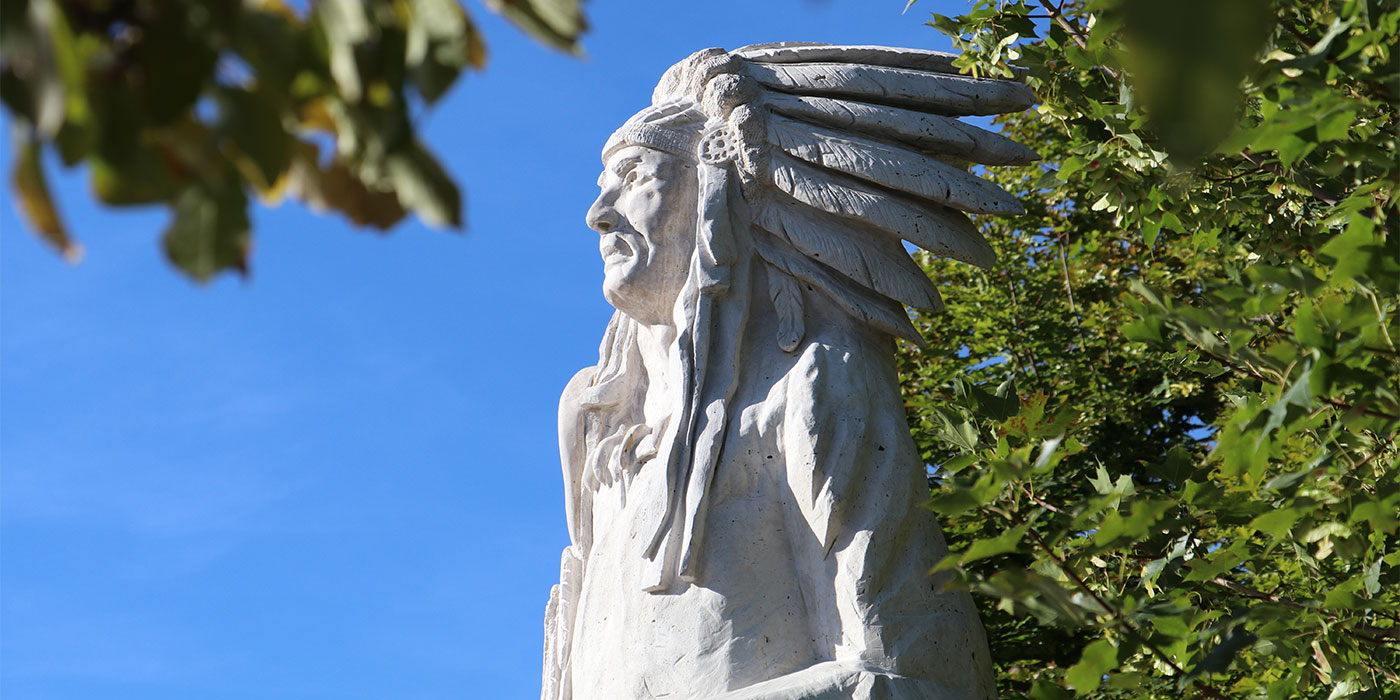
The statue of Chief Pocatello was sculpted by local artist J.D. Adcox and was officially unveiled on July 26, 2008.
- The statue was dedicated and unveiled by the group Valley Pride in July 2008.
- The statue is made of travertine.
- It is located at the Pocatello Visitor’s Center near the intersection of South 4th and South 5th Avenues in Pocatello, Idaho.
Artistic Context
Because there are no known photographs of Chief Pocatello, the sculptor J.D. Adcox worked closely with the Shoshone-Bannock Tribes and the chief’s descendants to ensure the sculpture provided a respectful and accurate depiction.
The monument stands near the Rotary International Rose Garden and is surrounded by interpretive markers detailing the chief’s life and the history of the Shoshone people.
Chief Pocatello (c. 1815–1884), whose actual Shoshone name was Tonaioza (meaning “Buffalo Robe”), was a major leader of the Northern Shoshone. He is remembered for his fierce protection of his people during the westward expansion of the United States and his eventual role in establishing a peaceful, if difficult, life on the Fort Hall Indian Reservation.
The Life and Leadership of Chief Pocatello
- Early Conflicts: In the 1850s, Pocatello led a band of Shoshone who resisted the influx of settlers along the Oregon and California Trails. These raids were largely retaliatory, sparked by the destruction of native food sources and attacks by white migrants.
- The Bear River Massacre (1863): Pocatello famously saved his band from the devastating Bear River Massacre by leading them away just before U.S. Army troops arrived.
- Treaties and Reservation: Recognizing that continued war was unsustainable, he signed the Treaty of Box Elder (1863) and the Fort Bridger Treaty (1868). He agreed to move his people to the Fort Hall Reservation in exchange for government supplies that often never arrived, leading to periods of severe starvation.
- Burial: Upon his death in 1884, he was buried according to tradition in a deep spring (now under the American Falls Reservoir) with his personal belongings and 18 sacrificed horses.
Why the City is Named After Him?
The city of Pocatello was named in his honor primarily due to his cooperation with the railroad.
- Railroad Right-of-Way: In the late 1870s, Chief Pocatello granted a right-of-way to the Utah and Northern Railway to cross the Fort Hall Reservation.
- Strategic Junction: The site where the railroad crossed the reservation became a major transportation hub known as “Pocatello Junction.”
- Incorporation: When the town was officially incorporated in 1889, the name “Pocatello” was chosen to recognize the chief’s influence and his permission for the railroad to pass through tribal lands.
Interestingly, “Pocatello” is likely a name bestowed by white settlers; linguists and the chief’s own daughter noted that the word has no meaning in the Shoshone language.
Pick a category below to find nearby places.